

Professional and managed services teams know maintenance matters. The harder question is whether they know what reactive maintenance is actually costing them.
This is one of those problems that can sit quietly in the background for a long time. A website launches. An application goes live. The team celebrates briefly and moves on to the next project. Over time, that new system becomes one more thing in a growing estate of frameworks, libraries, dependencies, hosting environments, SSL certificates, integrations, APIs, and security obligations.
Nothing looks especially urgent if you or your org has maintenance blind spots.
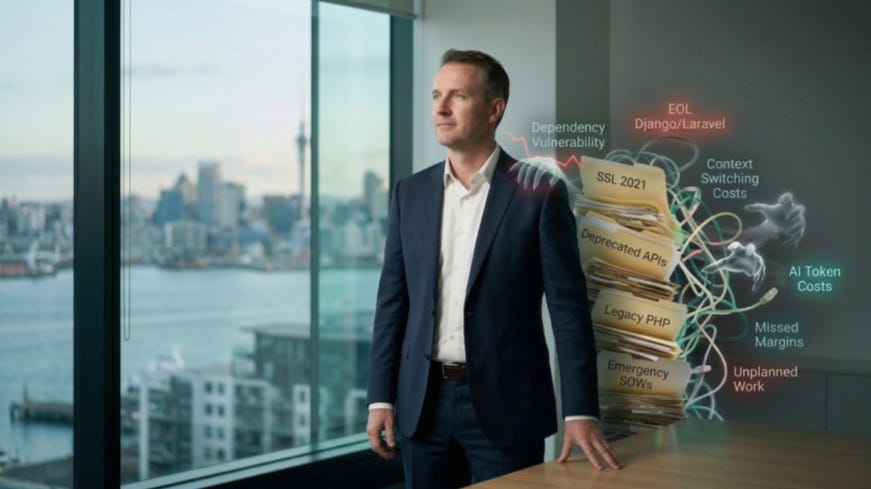
A framework reaches end of life (EOL). A dependency vulnerability is published. A client asks whether they are exposed. A developer has to stop planned work to investigate. A project manager has to re-scope work that now needs budgeting. Maybe a Statement of Work is required. Maybe a proposal or business case needs to be built. Someone then has to explain why something that “just worked” last week now needs time, money, and attention.
The technical fix may be a few hours, a few days, or in the case of larger upgrades and migrations, several months. The cost around the fix is usually the bigger problem.
In our whitepaper, Hidden Costs in Application Maintenance: How Proactive Agencies Win, we describe maintenance as a blind spot in agency operations. Not because teams are careless, but because the information needed to manage maintenance properly is often spread across engineering knowledge, Slack threads, spreadsheets, hosting platforms, existing application security (AppSec) tools, version control repositories, and individual memory.
Maintenance is often reactive. It starts after something fails, after a client escalates, or after a security risk becomes visible enough that it can no longer be ignored. The knowledge is also usually siloed. Developers may know where the risks are, but that does not mean project managers, account leads, delivery leads, or executives have a useful portfolio-wide view or know if a problem found in one project doesn’t also affect others.
That is where the issue stops being technical and starts becoming commercial.
Unplanned maintenance pulls people away from planned work. It creates context switching. It disrupts delivery momentum. It makes budget conversations harder. It can make an agency look less in control than it actually is.
What Reactive Maintenance Costs in Real Terms
Using conservative industry data and typical developer charge-out rates of USD $75–$150 per hour, the financial cost of ad-hoc maintenance can be modeled fairly quickly.
Take cross-portfolio end-of-life (EOL) planning as one example.
If EOL planning takes around 10 hours per project annually, spread across developers and project managers, then a 10-project portfolio represents roughly 100 hours of unplanned effort.
At USD $75–$150 per hour, that equates to USD $7,500–$15,000 per year in time that may not be properly forecast, budgeted, or recovered.
Now take cross-portfolio vulnerability review and risk analysis. If vulnerability review takes around 1 hour per project, per week, then a 10-project portfolio creates around 10 hours of recurring weekly effort. At the same charge-out range, that becomes approximately USD $3,000–$6,000 per month in avoidable cost.
That is before the wider operational cost is counted: context switching, delayed roadmap work, emergency client communication, re-planning, proposal effort, and the loss of confidence that comes when clients feel issues are being discovered late rather than managed early.
For one application, the cost may feel tolerable. Across 20, 40, or 100 maintained applications, the numbers start to look very different. This is the commercial shape of the problem.
Reactive maintenance is not just a technical risk. It is margin leakage hiding inside normal delivery operations.
Leveraging AI Makes This More Complicated at Scale
AI is making it faster to create software, scripts, internal tools, prototypes, features, and automation. That is useful, but it also means organisations may be creating more digital assets than they have maintenance discipline for.
Every new asset creates a future obligation. Dependencies need monitoring. Runtimes need patching. APIs change. Hosting environments age. Security risks emerge. AI-generated code may also introduce patterns that are harder to understand later, particularly when it was created quickly and without enough architectural context.
The AI cost model is changing as well. More AI platforms are moving toward usage-based pricing or tightening the economics around heavy use. So the cost of running and maintaining digital assets is no longer just hosting, software licences, support retainers, developer time, and security tooling.
AI usage itself becomes another cost line teams need to understand and justify.
That matters because the reactive maintenance cost is already material. Even a simple 10-project model can point to USD $7,500–$15,000 per year in unplanned EOL planning effort, and USD $3,000–$6,000 per month in recurring vulnerability review and risk analysis.
If AI increases the volume of software being created, and adds another usage-based cost layer to reviewing, analysing, remediating, and maintaining that software, visibility becomes more important, not less.
That creates a simple but uncomfortable question:
Are we creating more digital assets than we can afford to maintain well?
That is not an argument against AI. It is an argument for better visibility. Shipping faster is only useful if teams can still govern, secure, maintain, and explain what they have shipped.
The Fix is Only One Part of the Cost
A common mistake is to measure maintenance by the fix itself. That misses all the surrounding cost that customers may assume is simply “a cost of business.”
The maintenance question is no longer just
How much does it cost to fix this issue?
It is closer to
How much are we spending to discover, understand, explain, prioritise, and repeatedly rework issues we could have seen or planned for earlier?
What Changes When Maintenance is Planned
A proactive agency has a different conversation with its clients. It can see which applications are approaching end of life. It can identify which clients are affected by a vulnerability. It can plan upgrade windows before they become emergencies.
The tone of the conversation changes from,
We have a problem and need to fix this urgently
to:
We are tracking this across your environment. Here is what is coming, here is the likely impact, and here is how we recommend planning for it.
Commercially, it is significant. It builds confidence. It makes maintenance easier to budget. It gives project managers better information. It also creates a stronger basis for ongoing client relationships. Maintenance stops being only a cost centre and becomes part of the service model.
Where Metaport Fits
This is the problem we are working on with Metaport.
Metaport is designed to help agencies and digital teams see maintenance risk across the applications they manage. It brings together signals around end-of-life (EOL), dependencies, vulnerabilities, and SSL expiries, so teams can move from reactive discovery to proactive planning.
The value is in making maintenance risk visible at the portfolio level, in a way project managers, delivery leads, and leadership can actually use.
Because the hard part is not always fixing the issue. Often, the hard part is seeing it early enough to have the right conversation, with the right person, at the right time.
Want to stop maintenance from creeping up on you?